Where it all began
Writing a raytracer was a school homework excersise back in 2007. For this project I didn’t use source control so I don’t have history data. I think it was a one source file project when I submitted it.
In 2008 improvements were made and I split the code into more source files. In 2013 I imported them to git. This version had some issues:
- it contained an unfinished Kd-Tree implementation,
- there was a lot of dead code,
- it was very slow.
Let’s see some metrics. To get this initial code df76ccf link I needed to modify the Makefile like this:
@@ -39,7 +39,7 @@ $(BUILDDIR)/%.o: %.cc
 -include $(ray_OBJS:%.o=$(DEPDIR)/%.d)

 ray: $(ray_OBJS:%.o=$(BUILDDIR)/%.o)
-       @$(CC) $(LDFLAGS) -o $@ $^
+       @$(CC) $^ $(LDFLAGS) -o $@
        @echo "  LN    $@"

 clean:
Using gcc-10.2.1 it compiles to a 56936 byte x86_64 executable on
linux. This is the unstripped size.
$ size ray
   text	   data	    bss	    dec	    hex	filename
  35323	   2056	    624	  38003	   9473	ray
The program needs about 14 seconds on my machine to render the 1280x800 output image:
$ time ./ray
62.60% Output has been written to tracement.tga
94.40% Output has been written to tracement.tga
freeNode(0)
./ray  52.22s user 0.06s system 372% cpu 14.026 total
Here is the result rendering:
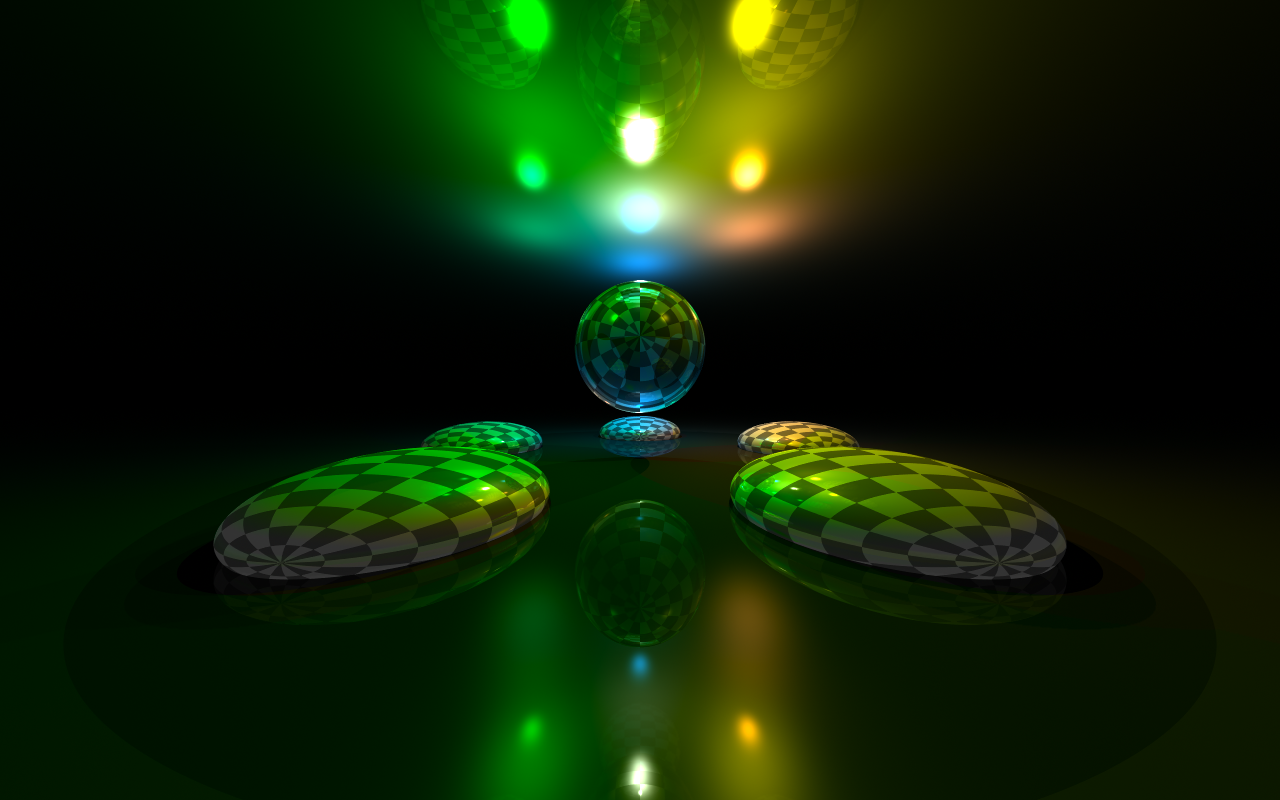
So that’s where I started from.
The initial goal was to see if I can speed the thing up.